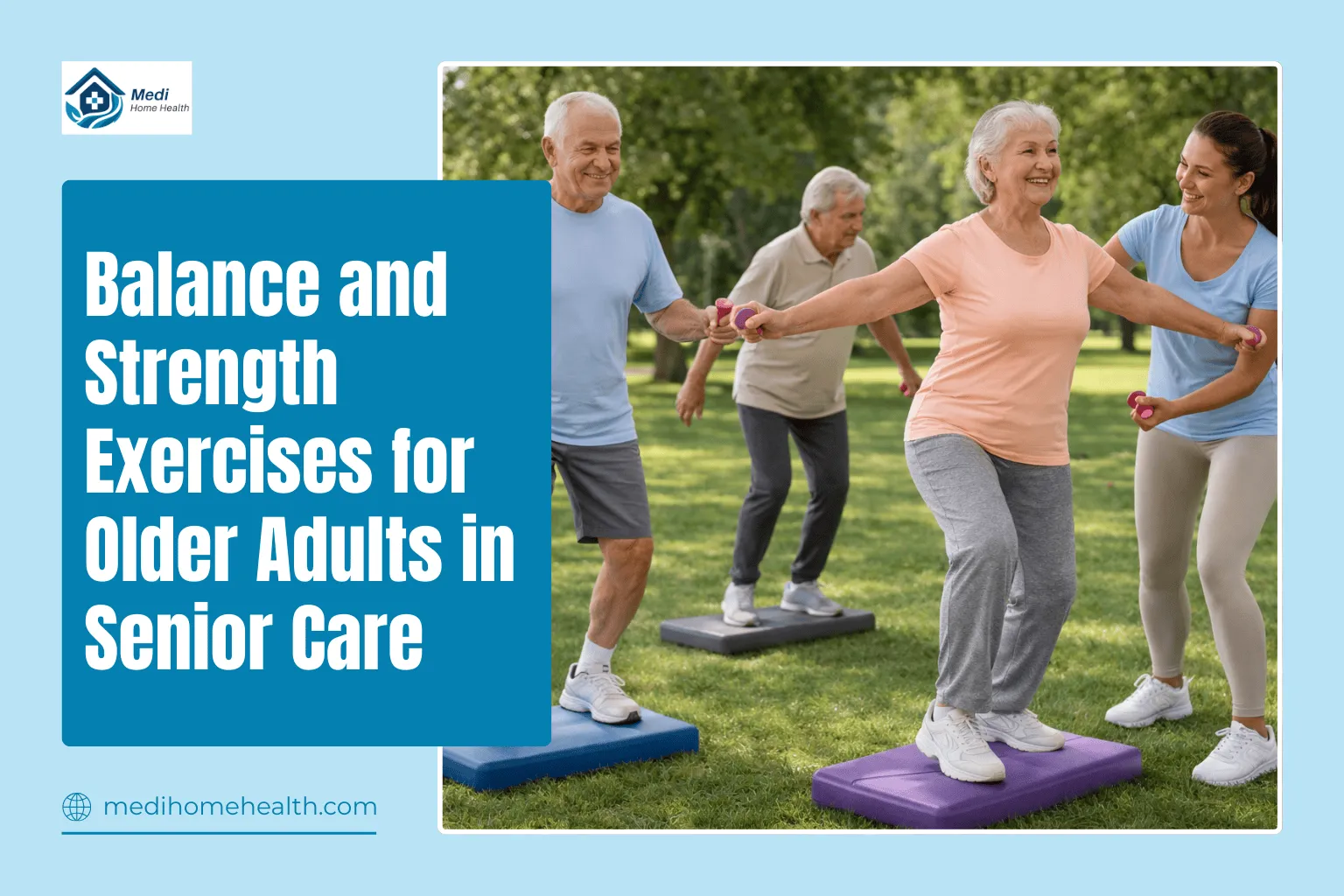
Falls are one of the most common and serious risks facing older adults. Each year, over 14 million seniors in the United States, roughly one out of every four people aged 65 and above, experience a fall. These incidents lead to more than 38,000 deaths every year and cause nearly 3 million emergency room visits, making falls the top cause of injury and injury-related death among older adults.
The positive takeaway is that falls are not unavoidable. Studies consistently show that balance training for seniors can lower fall risk by about 23 to 24 percent, while focused exercise routines improve strength, steadiness, and confidence. With regular fall prevention exercises done at home, many seniors can stay independent, feel safer moving around, and continue living comfortably.
How Balance Affects Fall Risk in Older Adults
Remaining stable depends on more than leg strength. Balance relies on eyesight, inner ear function, muscle strength, joint movement, and coordination between the brain and body. As people age, changes in these systems increase fall risk, which makes balance practice and prevention steps especially important.
Reasons Balance Declines with Age
Physical changes:
- Muscle strength slowly drops over time, decreasing by about 3 to 8 percent each decade after age 30, while overall muscle mass declines by roughly 3 to 5 percent per decade.
- Joint movement and flexibility reduce with age, limiting range of motion.
- Reaction time slows, making it harder to recover from slips or trips.
- Bone density decreases, raising the chance of fractures during falls.
Sensory changes:
- Vision changes can affect depth judgment and obstacle awareness.
- Inner ear changes interfere with balance and body positioning.
- Reduced sensation in the feet makes surface changes harder to detect.
Awareness of body position becomes less precise with age.
Health factors that raise fall risk:
- Using four or more medications greatly increases fall likelihood.
- Ongoing conditions such as arthritis, diabetes, or heart disease can limit mobility.
- A past fall doubles the chances of falling again.
How Falls Affect Older Adults
Physical effects:
- Hip fractures affect about 319,000 seniors each year, with most caused by falls.
- Head injuries from falls may have long-term effects.
- Healing and recovery often take longer for older adults.
Financial impact:
- Medical costs related to fall injuries exceed $80 billion each year.
- Medicare pays for roughly two-thirds of fall-related healthcare expenses.
Why Balance Exercises Help Prevent Falls
Research confirms that balance exercises can lower fall risk and improve stability, helping older adults feel safer and more confident during daily activities.
Evidence Supporting Exercise Programs
Study results:
- A large 2020 review of 116 studies involving more than 25,000 participants found exercise reduced fall rates by 23 percent.
- Balance-focused and functional exercises lowered falls by about 24 percent.
- Programs combining several exercise types reduced falls by nearly 28 percent.
Tai Chi practice lowered fall risk by roughly 23 percent.
How these exercises help:
- They improve posture control and reaction speed.
- They strengthen core muscles that support the spine and hips.
- They improve coordination among body systems.
- They reduce fear and build confidence while moving.
8 Balance and Strength Exercises to Prevent Falls in Seniors
These simple and safe exercises require little equipment and can be done at home, making fall prevention more practical and accessible.
Important: Always talk with a healthcare provider before beginning a new exercise routine.
Basic Safety Preparation
- Exercise near a solid counter or inside a corner for support.
- Place a chair behind you for added safety.
- Remove floor hazards and wear shoes with good grip and low heels.
- Keep eyes open unless guided by a trained professional.
- Make sure the area is well lit.
- Aim for about three balance sessions per week for best results.
Exercise 1: Standing Balance Levels
Based on the CDC’s balance testing method, this exercise builds steady balance step by step and supports fall prevention.
How to do it:
- Level 1 – Feet Apart: Stand with feet shoulder-width apart, arms relaxed.
Hold for 10 seconds, working up to 30 seconds.
- Level 2 – Feet Together: Stand with feet touching.
Hold for 10 seconds, progressing to 30 seconds.
- Level 3 – Semi-Tandem: Place one foot beside the arch of the other.
Hold for 10 seconds per side, building to 30 seconds.
- Level 4 – Tandem: Place one foot directly in front of the other.
Hold for 10 seconds per side, working up to 30 seconds.
Safety guidance:
- Keep eyes open during all levels.
- Use counter support at first and reduce help over time.
- Move to the next level only after mastering the current one.
- Practice with a chair behind you for safety.
Benefits: Improves standing balance, increases confidence, strengthens posture muscles.
Exercise 2: Standing on One Leg
This activity challenges balance while building strength in the supporting leg.
How to do it:
- Stand at a counter and hold lightly with both hands.
- Lift one foot a few inches off the floor.
- Hold for 10 seconds, working up to 30 seconds.
- Lower the foot and switch sides.
- Repeat three to five times per leg.
Progression ideas:
- Start with both hands on the counter, then one hand, fingertips, and finally hovering.
- Keep eyes open throughout.
- Breathe steadily during the exercise.
Benefits: Builds leg strength, improves balance response, supports everyday stability.
Exercise 3: Heel-to-Toe Walk
This moving balance exercise improves walking control used in daily life.
How to do it:
- Stand near a wall or counter for support.
- Place one foot directly in front of the other so the heel touches the toe.
- Walk 10 to 20 steps forward, turn carefully, and return.
- Focus on a fixed spot ahead to stay steady.
Safety notes:
- Move slowly and with control.
- Use support only if needed.
- Practice on a flat, clear surface.
Benefits: Improves moving balance, strengthens the core, and increases coordination.
Exercise 4: Toe Raises
This exercise strengthens the lower legs while challenging balance.
How to do it:
- Stand near a counter and hold lightly.
- Keep feet hip-width apart with knees slightly bent.
- Slowly rise onto your toes as far as comfortable.
- Hold for two to three seconds.
- Lower heels back down slowly.
- Repeat 10 to 15 times for one or two sets.
Safety tips:
- Use support the entire time.
- Move slowly without bouncing.
- Lift only as high as feels safe.
Benefits: Strengthens calves and ankles, improves walking push-off, supports balance.
Exercise 5: Side Steps
This side-to-side movement improves balance that daily routines often miss.
How to do it:
- Stand with feet together, hands on hips or holding a counter.
- Step to the right while staying upright.
- Bring the left foot to meet the right.
- Take 10 steps right, then 10 steps back left.
Safety notes:
- Make sure there is open space on both sides.
- Keep posture upright throughout.
- Use support when turning if needed.
Benefits: Strengthens hip muscles, improves side balance, supports movement in all directions.
Exercise 6: Chair Rise and Sit
This practical movement strengthens muscles used for one of the most common daily actions.
How to perform:
- Use a solid chair placed against a wall, feet flat on the floor and spaced hip-width apart.
- Lean forward slightly and press through your heels to stand up.
- Try not to use your hands on the chair arms if you can.
- Stand tall, then slowly sit back down with control.
- Repeat 8 to 15 times, focusing on steady movement rather than speed.
Progression tips:
- Begin with hands resting on thighs if support is needed.
- Move to crossing arms over the chest as strength improves.
- Control both the rise and the return to sitting; avoid dropping down.
Benefits: Builds leg and core strength, improves everyday balance, increases confidence with daily tasks.
Exercise 7: Balance with Added Motion
This activity challenges balance while also training coordination skills.
How to perform (Beginner – Seated):
- Sit upright in a sturdy chair with feet flat on the floor.
- Slowly turn your head side to side while keeping good posture.
- Add easy arm movements, such as reaching forward or out to the sides.
- Include simple thinking tasks like counting aloud or naming items while moving.
How to perform (Intermediate – Standing):
- Stand in a split stance with one foot slightly ahead, holding a counter lightly.
- Turn your head gently while staying balanced.
- Add small reaching motions while keeping one hand near the counter.
- Practice dual tasks, such as saying the days of the week while balancing.
Safety considerations:
- Keep eyes open during all home practice.
- Begin seated before moving to standing exercises.
- Maintain contact with the counter during standing work.
- Avoid wide or fast arm movements that may affect balance.
Benefits: Improves coordination, strengthens balance response, supports multitasking used in daily life.
Exercise 8: Gentle Tai Chi–Style Movements
These slow movements combine balance, control, and focused awareness.
Basic movements to begin with:
- Weight Shifts: Stand with feet apart and slowly move weight from one foot to the other.
- Easy Arm Swings: Gently swing arms side to side while staying balanced.
- Controlled Knee Lifts: Lift one knee slowly, pause briefly, then lower with care.
- Focused Reaching: Reach forward with one arm while keeping steady footing.
Guidelines to follow:
- Move slowly and with smooth control.
- Breathe deeply and evenly throughout each movement.
- Keep shoulders relaxed and posture upright.
- Pay attention to how your body feels as you move.
Important recommendations:
- Consider learning from a proven program such as Tai Chi for Arthritis and Fall Prevention.
- Attend a class before practicing on your own at home.
- Exercise programs that include balance training lower fall rates by about 23 percent.
- Tai Chi has also shown clear reductions in falls and fall-related injuries.
Benefits: Supports proven fall prevention, improves flexibility, lowers stress, strengthens mind–body awareness.
Setting Up a Safe Space to Exercise at Home
Essential Safety Steps
Preparing the exercise area:
- Remove loose rugs, cords, and clutter from the floor.
- Make sure the room is well lit.
- Choose a flat surface that does not slip.
- Keep pets out of the room during exercise.
Helpful safety items:
- Place a strong chair or counter within easy reach.
- Use non-slip mats on smooth floors if needed.
- Wear supportive shoes with good grip or go barefoot on non-slip surfaces.
- Keep a phone close by in case help is needed.
Personal safety tips:
- Exercise when alert, not right after medications that may cause dizziness.
- Choose times when you feel rested, not sick or overtired.
- Ensure lighting is bright and even in the exercise space.
- Wear low-heeled, non-slip shoes or exercise barefoot safely.
- Talk with a healthcare provider before starting new exercises.
- Begin slowly and increase difficulty over time to avoid injury.
Stop exercising right away if you notice:
- Chest pain or sudden trouble breathing.
- New dizziness or lightheadedness.
- Joint pain that gets worse with movement.
- Any sudden or unusual symptoms.
When Professional Help May Be Needed
Think about working with a physical therapist if:
- You have fallen recently or nearly fallen more than once.
- Balance problems or dizziness are ongoing.
- Medical conditions affect movement or stability.
- You want an exercise plan designed for your needs.
Creating Your Fall Prevention Routine
Regular practice is key to gaining results from balance exercises. A steady routine supports long-term improvement.
Weekly plan:
- Three balance sessions per week based on proven guidelines.
- Monday, Wednesday, Friday: Full balance routine lasting 15 to 20 minutes.
- Tuesday, Thursday: Walking or another light aerobic activity.
- Saturday: Longer exercise session or group class.
- Sunday: Gentle movement or rest.
Daily routine layout (15–20 minutes):
- Warm-up for two to three minutes with easy movement.
- Choose two to three balance exercises from the list.
- Include one still balance exercise and one moving balance exercise.
- Practice useful motions like sitting and standing.
- Cool down with light stretching or relaxation.
Tracking Progress and Staying Engaged
Ways to notice improvement:
- Keep a simple exercise record with time and difficulty.
- Track how long balance positions can be held.
- Pay attention to increased confidence during daily tasks.
Signs to stop and get advice:
- Ongoing dizziness during exercise.
- Sharp or worsening pain in joints or muscles.
- A clear increase in unsteadiness.
- Chest pain or breathing problems.
- New episodes of dizziness or lightheadedness.
Fall Prevention Beyond Exercise
Although balance training is important, full fall prevention also addresses other risk areas.
Home Safety Changes
Helpful updates to support exercise efforts:
- Install brighter lighting throughout the home.
- Add grab bars in bathrooms and near stairs.
- Remove loose rugs or secure them firmly.
- Place handrails on both sides of stairways.
- Use non-slip mats in tubs and showers.
- Keep walkways clear of clutter and cords.
Health Care Steps That Reduce Fall Risk
Key health actions:
- Review medications regularly with healthcare providers.
- Schedule yearly eye exams and update lenses as needed.
- Manage health conditions that affect balance.
- Maintain a healthy weight and drink enough fluids.
- Ensure proper calcium and vitamin D intake.
Home Care Support for Fall Prevention
For seniors with higher risk or recent falls, home care services can offer added safety and guidance.
When extra help may be useful:
- Recent falls or repeated near-falls.
- Strong fear of falling that limits activity.
- Complex medical issues affecting balance.
- Trouble completing daily tasks safely.
Benefits of professional home care:
- Caregivers trained in senior safety.
- Help with balance exercises and fall prevention routines.
- Support with medications and health tracking.
- Assistance with making the home safer.
How MediHomeHealth Supports Fall Prevention
At MediHomeHealth, our home care professionals recognize how important fall prevention is for staying independent. Using our Balanced Care Method®, we include fall safety as a core part of overall care planning.
Our fall prevention support covers:
- Caregivers educated in senior safety and fall reduction methods
- Help with keeping seniors active through regular exercise habits
- Home safety checks with practical improvement suggestions
- Communication with doctors and other health professionals
With MediHomeHealth, we thoughtfully choose caregivers who value fall prevention and can offer both skill and motivation to help seniors keep their balance, confidence, and independence at home.
Staying Independent Through Balance Exercise
Ongoing balance exercises for seniors provide value beyond reducing falls and help support overall health, independence, and daily comfort.
Physical health benefits:
- Improved core strength helps maintain upright posture
- Stronger legs support steadier walking
- Faster balance responses lower fall risk
Mental and emotional benefits:
- Greater confidence with less fear of falling
- Better movement ability supports self-belief
- Routine activity supports positive mood
Quality of life benefits:
- Ability to keep enjoying favorite pastimes
- Confidence to attend social activities
- Lower need for medical care and related costs
Taking the Next Step with MediHomeHealth
Balance exercises for seniors play an important role in fall prevention and help support independence and daily living. With steady practice, proper safety steps, and help from professionals when needed, seniors can lower fall risk while staying active and self-reliant.
Begin at your current level, move forward slowly, and keep balance exercises part of your routine. Whether you are noticing early changes or healing after a fall, balance training can still help.
Fall prevention focuses on keeping confidence, independence, and quality of life so aging at home remains possible. Balance exercises support long-term stability and continued enjoyment of daily life.
Reach out to MediHomeHealth to learn how our home care team can help with fall prevention and support the balance, confidence, and independence needed to remain comfortable at home.
FAQs – Frequently Asked Questions
What balance exercises work best for seniors?
Effective balance exercises for seniors include standing balance progressions, one-leg stands, heel-to-toe walking, calf lifts, side steps, chair sit-to-stand movements, balance with motion, and modified tai chi actions. These exercises can be performed safely at home using little equipment.
How often should seniors practice balance exercises?
Seniors should aim for three balance exercise sessions each week based on research-backed fall prevention guidance. Sessions should last 15 to 20 minutes and include both still and moving balance exercises.
Do balance exercises help reduce falls?
Yes. Studies show balance exercises can lower fall risk by about 23 to 24 percent in seniors. Programs that combine balance with other movements can reduce falls by up to 28 percent.
Are home balance exercises safe for seniors?
Balance exercises are generally safe when done correctly at home. Key safety steps include exercising near a solid counter, keeping a chair close, wearing non-slip footwear, maintaining good lighting, and checking with a healthcare provider before starting.
What equipment is needed for balance exercises?
Very little equipment is required. Seniors need a sturdy chair or counter for support, non-slip shoes or bare feet, good lighting, and a clear area to move. Optional items include non-slip floor mats and a nearby phone.
How soon do results appear from balance training?
Many seniors notice better confidence and steadiness within four to six weeks of regular practice. Clear improvements in balance and reduced fall risk often appear after twelve to sixteen weeks and continue to improve over time.
When should seniors stop exercising and get help?
Exercise should stop and medical advice should be sought if chest pain, sudden breathing trouble, new dizziness, worsening joint pain, or unexpected symptoms occur. Professional support is advised after recent falls or serious balance issues.
What leads to balance issues in older adults?
Balance problems in seniors are often caused by age-related changes such as reduced muscle strength, lower joint flexibility, slower reaction time, vision changes, inner ear issues, reduced foot feeling, and the effects of certain medications or health conditions.
If you want, I can run a second originality pass, tighten it further for SEO, or match it against a plagiarism checker threshold.
More Blogs You May Like

Caring for An Elderly Parent by Implementing Home Care
As a parent grows older, you might start to see small shifts in their routines, physical strength, or...
Read More
Assisted Living Vs Home Care – Making the Right Choice
When an aging parent starts to need extra help with daily tasks, choosing between home care and assisted...
Read More
Best Anti-Inflammatory Foods for Seniors Needing Home Care
The word “inflammation” is being used everywhere lately. From social media posts about digestion to podcasts focused on...
Read More