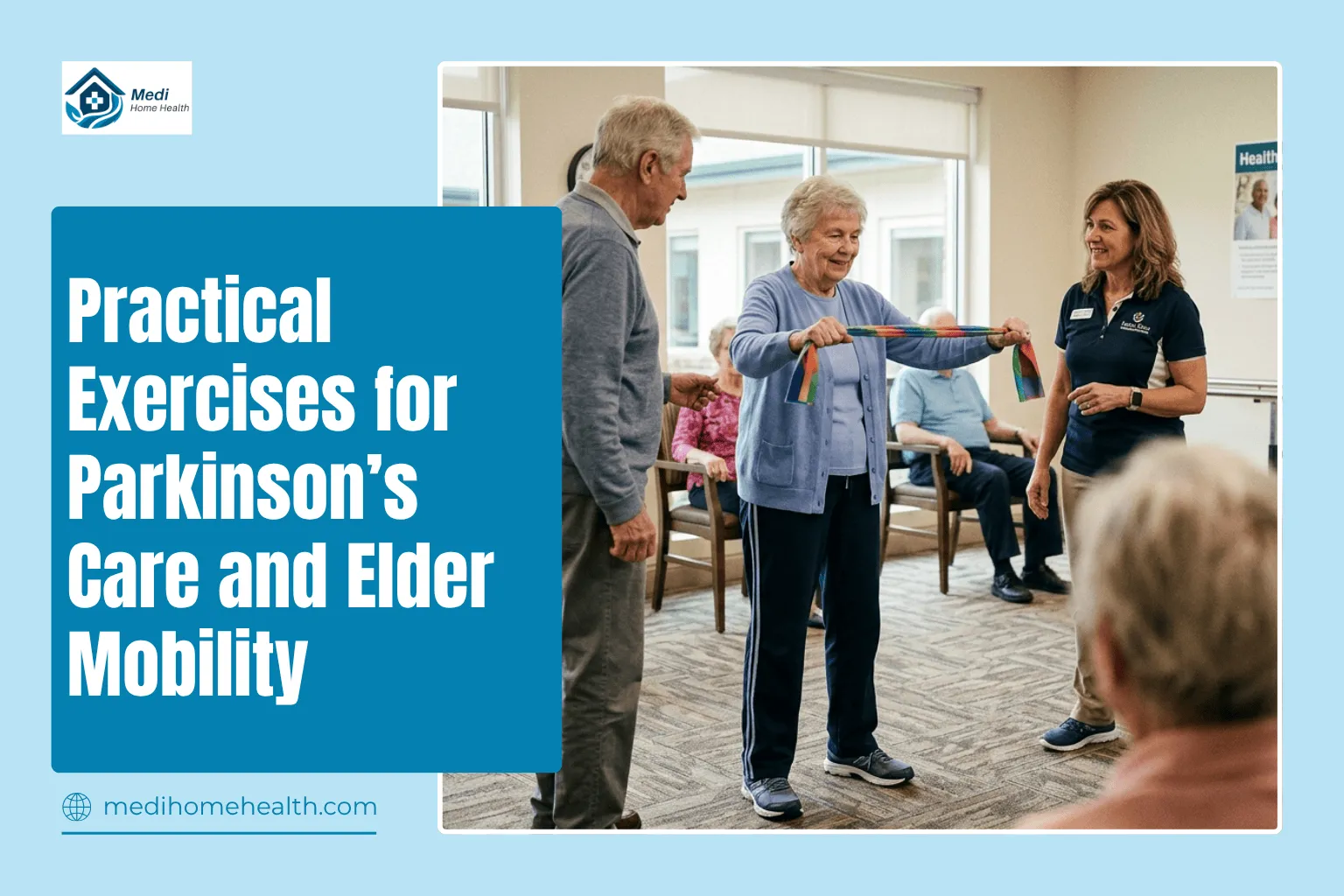
5 Important Exercises to Support Parkinson’s Safety and Mobility
If you want safe and practical ways to help improve movement, these 5 commonly recommended exercises for people with Parkinson’s disease may help:
- Large Arm Reach Exercises – Helps improve bigger body movements and ease stiffness linked to bradykinesia
- Heel-to-Toe Standing Practice – Supports balance and may lower the chance of falls
- Chair-Based Leg Raises – Strengthens leg muscles safely without putting too much strain on the body
- Slow Twisting Stretches – Helps improve flexibility and reduce muscle tightness
- Purposeful Walking Practice – Helps reduce shuffling steps and freezing while walking
These Parkinson’s exercises focus on balance, muscle strength, and controlled body movement, all of which are important for maintaining daily independence and improving safety.
Why Exercise Matters in Parkinson’s Care
For people living with Parkinson’s disease, physical movement is more than a way to stay active. It can also work as an important part of daily therapy and symptom management.
From a healthcare standpoint, regular exercise may help:
- Maintain movement abilities
- Slow down physical decline
- Improve coordination and self-confidence
Even so, many families feel uncertain about encouraging exercise.
“What if they lose balance?”
“Could more movement become unsafe?”
These concerns are understandable.
In many situations, the goal is not only movement, but movement performed safely and correctly.
When guided properly, exercise can become one of the most useful non-medication approaches available. Without proper supervision or awareness, however, it may increase the risk of falling.
This is one reason professional oversight, especially from a registered nurse, can play an important role in Parkinson’s care.
5 Recommended Exercises for Strength and Balance
These exercises are regularly used in neurological care programs. Each activity includes not only instructions for completing the movement, but also safety reminders and helpful clinical guidance.
1. Large Reaching Movements (Helping with Bradykinesia)
Purpose: Helps reduce slow or limited movement by encouraging the body to move with greater range.
How to perform:
- Sit or stand with good posture
- Lift one arm forward and upward using a larger movement
- Reach outward as far as feels comfortable
- Repeat slowly while switching arms
Clinical cues:
“Reach farther than feels normal”
“Think open and wide instead of tight and small”
Common mistakes:
- Moving too fast
- Keeping movements too small due to fear of losing balance
Safety tip: Stay close to a sturdy surface for support if balance feels unstable.
2. Heel-to-Toe Standing Balance Exercise
Purpose: Helps improve balance control and body stability while lowering fall risk.
How to perform:
- Stand with one foot directly ahead of the other so the heel touches the toes
- Hold the position for about 10 to 20 seconds
- Switch foot positions and repeat
Clinical cues:
- Keep your eyes looking ahead instead of downward
- Lightly tighten core muscles while balancing
Common mistakes:
- Looking at the floor, which may affect stability
- Holding your breath during the exercise
Safety tip: Always practice near a stable chair, wall, or countertop for quick support if needed.
3. Chair-Based Leg Stretch Exercise
Purpose: Helps strengthen the thigh muscles that support standing up and walking safely.
How to perform:
- Sit upright on a stable chair
- Slowly raise one leg until it becomes straight
- Hold the position for 3–5 seconds
- Lower the leg carefully and repeat
Clinical cues:
- “Raise slowly and lower with control”
- Keep your back straight while moving
Common mistakes:
- Leaning too far backward
- Dropping the leg too fast
Safety tip: This exercise works well for people with greater fall concerns because it reduces the need for standing balance.
4. Slow Twisting Stretch Movements
Purpose: Helps ease body stiffness and improve movement through the middle of the body.
How to perform:
Sit or stand with an upright posture
Gently turn your upper body toward one side
Pause briefly before returning to the middle
Repeat the movement on the opposite sid
Clinical cues:
Keep all movements slow and steady
Do not push beyond a comfortable range
Common mistakes:
Making sudden or rushed motions
Twisting too far and creating discomfort
Safety tip: Stop the exercise right away if dizziness or pain appears.
5. Focused Walking Practice (Helping Reduce Freezing Episodes)
Purpose: Supports smoother walking patterns and may reduce shuffling or freezing while moving.
How to perform:
- Walk forward in a straight direction using intentional steps
- Focus on lifting the feet and moving the arms naturally
- Maintain a steady pace by counting or using movement cues if helpful
Clinical cues:
- “Take larger steps”
- “Place the heel down before the toes”
Common mistakes:
- Taking short shuffling steps
- Pausing suddenly and triggering freezing episodes
Safety tip: If freezing happens, stop briefly, adjust posture, and restart movement using a clear cue such as counting or imagining a line on the floor.
Clinical Safety: Watching for Non-Movement Symptoms During Exercise
Exercise for Parkinson’s involves more than muscle movement. It also requires attention to how the body reacts internally during activity.
From a clinical point of view, healthcare providers often monitor:
Heart Rate and Blood Pressure
Some people with Parkinson’s may develop orthostatic hypotension, which can cause dizziness after standing up.
Signs to monitor include:
- Feeling lightheaded
- Sudden tiredness
- Loss of steadiness
Breathing Changes and Fatigue
Some patients may experience:
- Shortness of breath during mild activity
- Quick drops in energy levels
These symptoms may relate to:
- Medication schedules
- Changes affecting the autonomic nervous system
An Important Clinical Observation
In many situations, the main risk is not always the exercise itself. Problems may happen because physical changes during movement go unnoticed.
This is where trained medical supervision becomes very important.
At MediHomeHealth, physical activity is not viewed as a basic exercise routine. Instead, it is treated as structured mobility support guided by clinical knowledge.
Our nurse-led program focuses on:
- Monitoring balance exercises closely
- Adjusting activity levels depending on fatigue and body response
- Recognizing possible fall hazards inside the home
- Sharing observations with the patient’s healthcare providers
In everyday care, this may include:
- A nurse staying close during balance exercises
- Changing exercises when small balance problems appear
- Responding early before a fall risk becomes dangerous
Many families do not realize how quickly small movement difficulties can become more serious.
Our goal is to help ensure movement stays:
- Safe
- Organized
- Helpful for long-term mobility support
Conclusion: Building Confidence Through Daily Movement
For people living with Parkinson’s disease, movement is not only exercise. It is an important part of preserving independence and slowing physical decline.
Without proper guidance, however, even basic exercises may involve certain risks.
The key difference comes from how the exercises are performed and whether trained support is available during activity.
With proper clinical supervision, everyday movement can become safer, more organized, and more beneficial.
To learn how a nurse-supported mobility program may help your loved one at home, visit: MediHomeHealth
A personalized and supervised plan can help turn simple daily activity into steady progress, improved confidence, and safer movement over time.
More Blogs You May Like

Benefits of In-Home Care for Your Loved Ones
Home is often where people feel safest and most at ease. Staying in a familiar place, surrounded by...
Read More
How Pedaling Help Seniors Living with Parkinson’s Disease
Parkinson’s disease affects millions of Americans and gradually impacts the brain’s ability to control movement. As the condition...
Read More
Holiday Care Tips for Family Caregivers
The holiday period brings many moments people look forward to, from catching up with relatives and friends to...
Read More