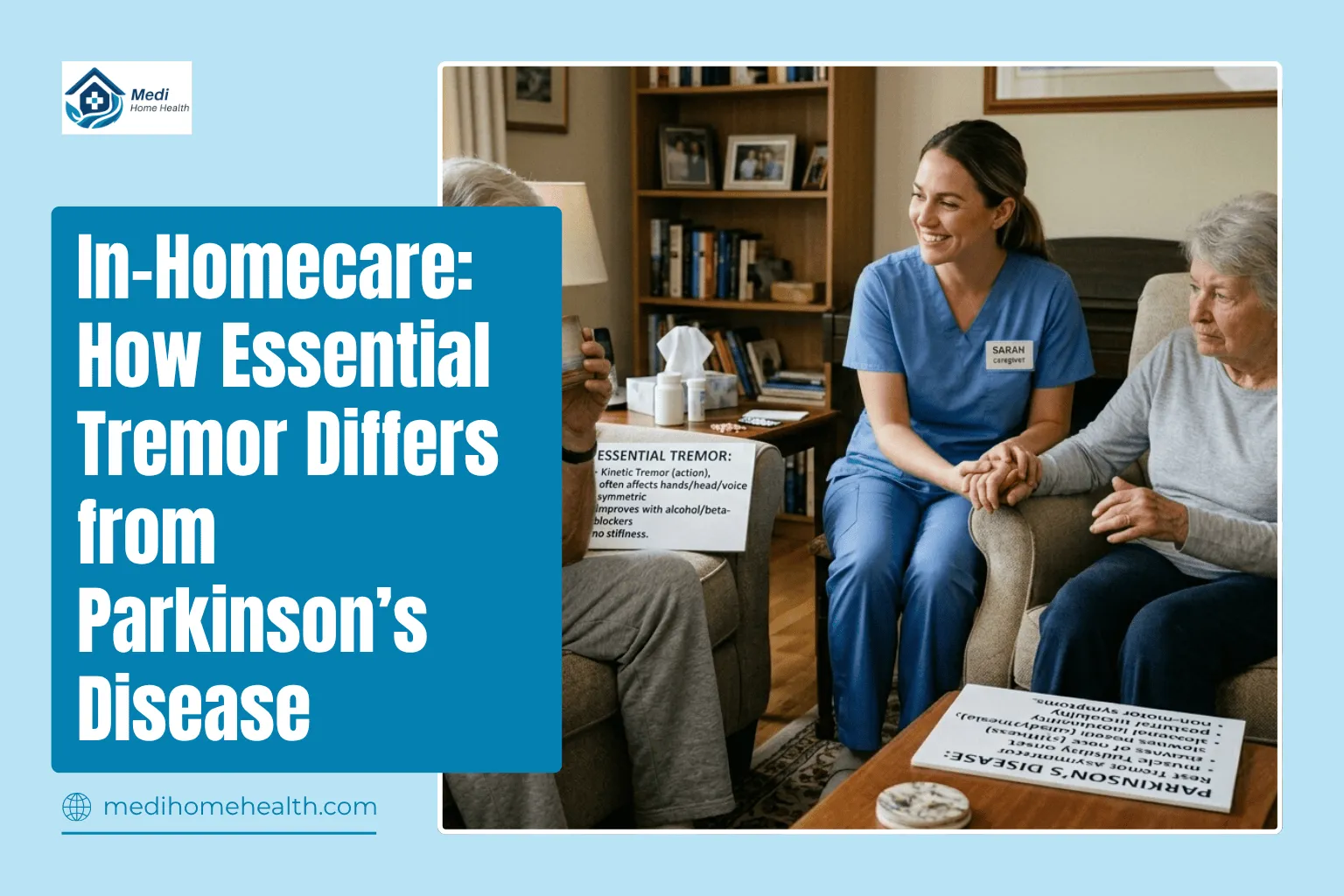
If you or someone close to you has been dealing with ongoing shaking in the hands, head, or voice, it’s natural to wonder what may be behind it. Learning about the possible causes is the first step toward getting a proper evaluation and exploring available support and treatment options.
When Tremors Start Affecting Everyday Life
Shaking can interfere with routine activities and create worry, especially when the source is unclear. Many people wonder whether the symptoms point to Parkinson’s disease or another condition such as essential tremor.
Both disorders become more common with age, and although they can appear alike at first, they have important differences. Understanding those differences can help families pursue appropriate treatment, practical assistance, and greater confidence about the future.
Below, we’ll compare the symptoms of essential tremor and Parkinson’s disease and discuss how people in Loudoun County and Virginia can find professional care at home.
Understanding Essential Tremor
Essential tremor is the most frequently diagnosed movement-related disorder. It usually causes repeated shaking while a person is performing an activity, such as drinking from a cup, fastening clothing, or writing a note. This type of shaking is known as an action tremor.
Key Facts
- It may be hereditary in nature.
- It often affects both hands and can also involve the head or voice.
- It generally does not cause stiffness, walking problems, or balance difficulties.
- It can begin at different stages of life, including early adulthood or middle age, and usually worsens gradually.
Essential tremor is not considered life-threatening, is separate from Parkinson’s disease, and does not involve progressive nerve cell loss. Even so, it can make daily tasks more challenging.
The good news is that several treatment options are available. We’ll cover some of those choices later, including ways to connect with specialists who can help control symptoms.
Understanding Parkinson’s Disease
Parkinson’s disease is a progressive neurological disorder that commonly causes shaking when the body is relaxed and not actively moving. This symptom is known as a resting tremor. It often begins on one side of the body and may resemble a rolling motion of the fingers. Tremors, however, are only one part of the condition.
Key Facts
- It can lead to slower body movements, known as bradykinesia. This may appear as difficulty getting started with movement, slower performance of routine tasks, reduced blinking or facial expression, and shorter steps while walking.
- It may also cause muscle stiffness in the arms, legs, neck, or torso, which can contribute to discomfort and pain.
- It can affect stability and coordination, raising the likelihood of falls.
- It may produce symptoms beyond movement, including tiredness, sleep disturbances, mood changes, and thinking difficulties. In later stages, some individuals may develop dementia.
Tremors associated with Parkinson’s often lessen or stop when a person begins a voluntary movement.
Parkinson’s disease usually develops gradually, and symptoms tend to increase over time. Although the exact cause remains unknown, researchers believe both genetic and environmental influences may play a role.
Key Differences Between the Two Conditions
Several characteristics can help distinguish essential tremor from Parkinson’s disease:
- When symptoms occur: Essential tremor typically appears during activity. Parkinson’s tremor is usually most noticeable during rest.
- Where symptoms begin: Essential tremor commonly affects both sides of the body. Parkinson’s often starts on only one side.
- Additional symptoms: Essential tremor mainly involves shaking. Parkinson’s disease is often accompanied by stiffness, slower movement, and other mobility-related changes.
A movement disorder specialist can assess all symptoms together and help determine the most appropriate diagnosis and treatment approach.
How Tremors Are Diagnosed
Obtaining an accurate diagnosis begins with an evaluation from an experienced specialist.
The Evaluation Process
- Review of Medical History: A movement disorder specialist will discuss your symptoms, including when the tremor began, factors that improve or worsen it, which body parts are involved, family medical history, and any medications you currently take.
- Neurological Assessment: During the examination, the neurologist will observe tremor patterns, check for muscle rigidity, evaluate movement speed, assess walking and balance, and look for other neurological findings.
- Ruling Out Other Conditions: Your physician will consider other medical issues that could be contributing to the tremor and determine whether additional testing is needed.
- Imaging and Testing: Depending on the situation, tests may include MRI imaging or specialized scans such as a DaTscan to provide further information.
Treatment Approaches for Everyday Living
Although there is currently no cure for either essential tremor or Parkinson’s disease, many treatments can help reduce symptoms and support a good quality of life.
For essential tremor, medications such as propranolol and primidone are frequently prescribed. Other treatments, including gabapentin, topiramate, and certain anti-anxiety medications, may also be considered in some situations.
For Parkinson’s disease, treatment often focuses on increasing or supporting dopamine activity through medications such as levodopa and carbidopa. Physical therapy, occupational therapy, speech therapy, and stress-reduction strategies may also play an important role. In some cases, advanced options such as focused ultrasound or deep brain stimulation surgery may be recommended.
Finding Support and Care in Loudoun County and Virginia
If all of this feels like a lot to manage, remember that help is available. MediHomeHealth provides in-home support services throughout Loudoun County and Virginia and can work alongside your medical team to deliver dependable, compassionate care.Whether you are just beginning to notice tremor symptoms or are supporting a loved one who already has a diagnosis, reaching out for professional guidance is an important step. Our caregivers can assist with daily activities, medication reminders, companionship, and ongoing support designed to help maintain comfort, confidence, and independence.
More Blogs You May Like

How is End-of-Life Care Managed
End-of-life care is not only focused on medical support, it is also about respecting a person’s choices, keeping...
Read More
Foods that Can Help Protect Against Dementia
Worried about memory Changes with age? Concern about memory as we grow older is very common. Nearly everyone...
Read More
Home Health Covered by Medicare in 2026
When an elderly parent requires home care, knowing how Medicare applies becomes important for making sound care choices...
Read More